Irwindale 1975 to Sittard-Geleen 2026
On a cold April morning in 1975, fourteen human-powered machines came to a California raceway. Half a century later in Sittard-Geleen, 110 competitors faced four races, a day of heat and a grid full of machines that the first builders might still have recognised.
Between those two weekends, the race moved from a timing trap to city streets, motor circuits, hill climbs and long-distance events. The people building the machines also took the idea onto water and into the air. Follow the teams, the organisers and the numbers they left behind, from the first sprint to the modern Worlds.

Dennis Turner / Geograph · CC BY-SA 2.0
Read the history in three eras
The longer chapters follow the designs that changed each period, the races that tested them and the surviving lists of vehicles.

1933–1994
The pioneers
The Vélocar, Irwindale and the workshops that sent one, two or three riders through the same timing trap.

1995–2009
Across the Atlantic
Lelystad, Interlaken, Ghent and the new club-hosted formats. See what early model lists can tell us.
2010–2026
The modern Worlds
From streets and motor circuits to lap timing and model counts. Compare the designs that stood out on each course.
1933–1974
Before there were championships
On 7 July 1933 at the Parc des Princes, Francis Faure rode 45.055 kilometres in an hour. His bicycle, Charles Mochet’s Vélocar, supported him in a chair-like seat with his feet out in front. It was an exposed recumbent, an important detail in a story often told as though the shell came first. The position itself changed the shape that met the wind. The UCI’s 1934 definition excluded this design from its races and records. Human-powered racing would eventually develop its own events and rules.
The link to California begins with an engineering question. Chester “Chet” Kyle and others were looking at the energy it takes to keep a bicycle moving, particularly at speeds where air resistance matters most. A shell could give the bicycle and rider a smoother outline. It could also make a bicycle that steered poorly in a crosswind, trapped heat, vibrated or gave its pilot a poor view. The 1977 Human Power account describes just those difficulties in the early trials. It is a reminder that streamlining had to work in air, on wheels and with a person inside at the same time.
A titanium Teledyne racing bicycle went under Kyle’s shell. Ron Skarin, a US Olympic cyclist, practised at first light on a naval airstrip at Los Alamitos, when the air was calmer. On 11 November 1974 he averaged 40.63 mph (65.39 km/h) over a mile. The project had a number people could argue about and a test others could repeat. The publicity helped turn a group’s experiments into an event. Chet Kyle and Jack Lambie set about finding out what other builders and riders would bring to the same stretch of track.

Eva K. / Wikimedia Commons · CC BY-SA 2.5
Sources Arnfried Schmitz on Mochet and Faure · Human Power The 1974 trials and the founders’ account · Human Power See Faure in the 1933 Gallica newspaper archive
1975–1977
Fourteen machines come to Irwindale
On 5 April 1975, roughly 300 spectators turned up at a cold California dawn. Lambie and Kyle ran the first International Human Powered Speed Championships at Irwindale Raceway, with Paul MacCready as official timer. MacCready also provided the trophies. The gathering had the character of a wager made public. A fairing on an upright bicycle, an experimental reclined tricycle and a tandem could each take a turn and bring back a number from the timing traps.
Skarin won the single-rider 200 metres with 44.69 mph (71.92 km/h), ahead of Gibby Hatton and Mario Palombo. Hatton was riding another streamlined racing bicycle. Palombo, in third, was already showing that a reclined tricycle could be quick. Phil Norton and Chris Deeton went slightly faster than anyone else that day in a streamlined tandem. In the results, the single-rider and multiple-rider classes answer two different questions. Give two people the same aerodynamic envelope and there is more power to call on, but a longer body, more mass and a harder job of keeping the effort in step.
In 1976, student volunteers helped Kyle run the second meeting. Raleigh provided prize money and AeroVironment provided trophies. One machine to watch was Abbott’s own fully streamlined bicycle, on which he lay face down. The winning single-rider speed climbed to 47.80 mph (76.93 km/h). The Mount Baldy Cycle Club’s three-rider machine went faster again. When teams appeared with different numbers of riders, the entrant, owner, builder and people inside the machine could all be different. The surviving result sheets let us recover many of those names.
A permanent organisation had become necessary to set common rules and recognise performances. On 28 March 1976 the International Human Powered Vehicle Association (IHPVA) was founded. Abbott was its first president, Alec Brooks vice-president, and Kyle executive secretary. The original journal sets out an ambition wider than competition. Better vehicles for everyday human-powered travel could emerge from the work of people trying to build a fast one.
Darryl LeVesque directed the 1977 meeting at Ontario Motor Speedway. Ralph Therrio won the solo division inside Paul Van Valkenburgh’s Aeroshell, a four-wheel vehicle with its pilot prone and driving with hands and feet. Ash and Hatton came within seven hundredths of 50 mph in their tandem. The shapes had diverged quickly. A racing bicycle in a fairing still had a place, alongside reclining designs built from the beginning around their shells.
| Edition | Venue | Vehicles and results | Single-rider winner · 200 m | Multiple-rider winner · 200 m |
|---|---|---|---|---|
| 1975 | Irwindale Raceway, California | 14 vehicles in the report · 15 result rows | Ron Skarin, 44.69 mph | Phil Norton and Chris Deeton, 44.87 mph |
| 1976 | Irwindale Raceway, California | 26 vehicles reported · 24 rows with a speed | Allan Abbott, 47.80 mph | Alan Stephens, Darryl LeVesque and Mark Orr, 48.95 mph |
| 1977 | Ontario Motor Speedway, California | Over 50 vehicle entries · 34 timed results | Ralph Therrio, 49.38 mph | Jerry Ash and Gibby Hatton, 49.93 mph |
The 1975 report says 14 vehicles came to the track, while the printed table has 15 rows. The 1977 journal counts entries and the table counts timed results. The surviving records give a good view of how quickly interest grew, even though a consistent census of individual riders for the three meetings remains to be assembled.
Sources IHPVA foundation, organisers and attendance · Human Power The original 1975–1977 results and period photographs Chet Kyle on the making of the first journal
1978–1982
The boats on wheels get faster
Read the names on the starting sheets for Ontario and it soon becomes difficult to picture a conventional bicycle. White Lightning, built by a Northrop University team, was a very long, low tandem tricycle. Its pilots lay on their backs. Tim Brummer describes a machine conceived for speed on a racetrack, with poor visibility and very little ground clearance. You could make such a vehicle work for a timed straight and still have a great deal to solve before taking it around a corner in company.
Jan Russell and Butch Stinton recorded 54.43 mph (87.59 km/h) on White Lightning in 1978. They returned with changes to the drive and wheel covers in 1979, passed the 55 mph threshold and won the Abbott Prize. The quickest run in the multi-rider event went to a different vehicle. The Vector Triple turned three riders into one low silhouette, with a tubular steel frame and a composite shell. Dave Grylls, Scott Andrews and Leonard Nitz powered it. The race report’s caption gives 57.07 mph and the IHPVA’s record register gives 57.06 mph. A higher figure also appears in the report’s prose. The register’s 57.06 mph is used for the record comparison below.
A Vector tandem carried Grylls and Leigh Barczewski to 62.92 mph (101.27 km/h) over 200 metres at Ontario in 1980. That same meeting also produced a 56.55 mph solo Vector run by Grylls. A contemporary annotation in the record register credits Sarah Jackson, Sheri Bowen and Diane Sandlin with 47.59 mph in a women’s three-rider vehicle. These are different machines with different numbers of riders. The tables are a record of several branches of design opening up at once.
The calendar was changing too. Closed-course races and starts that made riders get into their vehicles under the clock put a value on things seldom tested in a sprint lane. A rider had to see other people, stay cool, turn the machine and accelerate again and again. At Pomona in 1981 the road programme included rolling and Le Mans-style starts. The 1982 footage makes that history visible. It shows the machines of an event that took place at Irvine and Carson, before moulded velomobiles became familiar on a world championship grid.

1979 documentary, scanned by 16mm Time Machine. The opening and the sequence from 14:20 show the Ontario speed meet.

Period footage uploaded by Warren Beauchamp. Irvine and Carson, California.
Sources The contemporary Vector and White Lightning report IHPVA flying 200 m register Tim Brummer’s design history Pomona 1981 Irvine and Carson 1982
1983–1994
Speed, endurance and machines to live with
From the California speedways, the championships went to Indianapolis, where the Indiana chapter also hosted a scientific symposium in 1983. A community that had once gathered to watch a few fairings run through a trap was building a circuit for its ideas as well as its vehicles. A team could talk through the theory one day and discover the practical flaw on the next. In 1984, Carl Sundquist took Tim Brummer’s Lightning X-2 to 57.394 mph in the flying sprint. The following year Jim Glover exceeded 50 mph on a faired Moulton at Indianapolis, a different route to speed built around a conventional riding position.
In 1986, the meeting travelled to Vancouver. Expo 86 gave the twelfth international speed championships a public stage for both land and water racing. Human-powered flight was also part of the wider programme. Fred Markham covered more than 41 miles in the hour at Vancouver. In a separate 1986 achievement, he rode Gardner Martin’s Gold Rush to 65.484 mph and won the DuPont prize. The machine is held by the Smithsonian. The prize sprint and the championship hour belong on separate lines. One measures speed through a short trap after a run-up, the other the distance a rider can maintain for sixty minutes.
Read the competition reports through the next few years and the word “fastest” needs a distance beside it. Visalia in 1988 had a practical-vehicle competition as well as sprint times. At Adrian in 1989 Markham covered 73 km in the hour. At Portland in 1990, Matt Weaver’s Cutting Edge edged the Gold Rush team in a 20-mile criterium. He did it again in Milwaukee in 1991 against Gold Rush LeTour. A vehicle for these races had to be usable while the rider was tired, surrounded by traffic and committed to another lap.
One of the clearest demonstrations of changing classes came at Blaine, Minnesota, in 1993. Wimpie van der Merwe won the open, GT and unfaired 200 m divisions. His front-wheel-drive machine could be raced in different forms by removing parts of the shell between runs. The report counts at least 58 land vehicles at the meeting. Eureka followed in 1994 with streamliners, utility cycles, all-terrain vehicles and boats. Stop at the time sheets from this period and you find an event asking both how fast human power could go and what else it could move.

Sandra Cohen-Rose and Colin Rose / Wikimedia Commons · CC BY 2.0
Sources Indianapolis and the symposium Vancouver 1986 Gold Rush · Smithsonian collection IHPVA · DuPont prize and speed milestones Portland race report Blaine 1993 and the three divisions Eureka 1994
1995–1999
The championships cross the Atlantic
Lelystad in 1995 was the first European host identified by HPV Deutschland’s historical chronicle. For a time there might have been no meeting at all. The original organisers withdrew, according to Human Power. Marielle Bakker and Sacha Knoop took over. Instead of treating the weekend as a single sprint, they pulled together tests that used very different parts of the city. A 50 m sprint took racing into a shopping centre. A DAF proving ground gave the six-hour race somewhere to run.
Wouter Suverkropp’s account conveys what it felt like to turn up. He travelled the last part of his journey with another recumbent rider. At the meeting he found compact home builds, low racers and back-to-back tandems. Visitors could try machines such as the Flevo Amigo and a hand-powered M5 trike. A suspended, bodied Bendtsen stood out for winning the criterium final. The meeting connected racing to the arguments builders were having about suspension, room for a rider, visibility and the uses of a fairing on an ordinary road.
The move to Europe was a turning point, with North American meetings still in the chronology. In 1996 the University of Nevada, Las Vegas, helped stage the twenty-second championships. The university’s advance notice expected more than 100 entries. That is a forecast. On the course used for the 200 metres, Sam Whittingham recorded 118.0 km/h. The course was too steep for the run to be accepted as a record. Championship placings, measurements and record ratification each preserve something different about the same run.
In 1997, HPV Deutschland and local organisers led by Ludger Bütfering brought the 200 metres to the streets by Cologne Cathedral, used the Müngersdorf velodrome and held a 65 km Long Tour. Surviving sheets distinguish three divisions in the 200 metres. The same year is a turning point in the associations’ history. The WHPVA’s account dates the reorganisation of the original IHPVA into an international body of national associations and a separate American body to 1997. After later changes, the international body took the name WHPVA in 2009. That explains why the same initials can mean different bodies in documents from different years.
In 1999 Future Bike CH wanted to bring land and water racing to Interlaken. Rolf Bruckert took over the organisation through Velobüro when the project was in danger of falling through, according to SwitzerlandMobility’s account. The result was a public festival, with machines on roads and on the water and a human-powered aircraft as part of the spectacle. Theo Schmidt’s profile connects the festival with the builders experimenting across those disciplines. A recumbent, a pedal boat and an aircraft put different demands on a human engine, yet the same people could work on several of them.

Theo Schmidt / Wikimedia Commons · CC BY 2.5
Sources Lelystad and the contemporary accounts Wouter Suverkropp · Human Power UNLV advance notice Las Vegas result and record conditions HPV Deutschland’s illustrated history SwitzerlandMobility on Interlaken WHPVA institutional history
2000–2019
The clubs make the Worlds their own
By 2000 a weekend could be understood as a championship in its own right, with a rider’s results accumulating across very different events. The twenty-sixth edition at Blaarmeersen in Ghent left a particularly useful set of timing sheets. The open, unfaired and women’s records preserve one-hour and four-hour events, flying tests, a 250 m fastest lap and standing-start distances. Frederik Van De Walle heads the published unfaired four-hour sheet. The archive also labels certain runs as hour-record attempts. The race meeting and the attempt at a record could occupy the same venue and produce separate documents.
In 2001 the British Human Power Club took the Worlds through Brighton, Hove and Goodwood. David Hembrow remembers arriving with a group of recumbent racers from Cambridge who had never entered any world championship. His early Speed Ross and the steep hill to the campsite became part of the story alongside the timed races. The printed points tables name Ian Chattington and Rosmarie Bühler as champions. The Goodwood photograph at the top of this page records a scene that would have been unfamiliar to the organisers standing by the timing traps in 1975. Several riders are racing together around a circuit, each making choices about line, pace and the other people around them.
North American events were still part of the record. Brantford, Ontario, hosted the twenty-eighth International Human Powered Speed Championships in 2002, including utility and water competitions. The surviving entrants list has 55 numbered entries. Friedrichshafen paired land racing and boats at Lake Constance in 2003 and shared the week with Eurobike. Lelystad and Cycle Vision returned in 2004. In 2006 Allègre, in France’s Haute-Loire, reported more than 150 riders. Barbara Buatois won the women’s title and Hans Wessels the men’s.
The lower European racing bicycles and the new all-weather velomobiles grew up together. Allert Jacobs and Ymte Sijbrandij started their business in 1999 after working with Flevobike. Velomobiel.nl traces the Quest to their experience with aluminium and composite Alleweders, and lists an April 2000 delivery for one of its earliest recorded Quests. Weather protection and luggage space belonged in the design brief. A shell that helped a machine use less power at commuting speed also had a place in a long race. The two jobs still called for different choices about ventilation, mass and access to the drivetrain.
The British championship at Bentwaters in 2008 used a former airfield. Jersey in 2010 put a coastal time trial beside a criterium through the centre of Saint Helier. At Monza in 2011, a motor-racing circuit made room for the 200 m sprint and the one- and three-hour races. In 2013, Leer hosted racers on land and on water, with 220 participants across disciplines from 14 nations according to HPV Deutschland. Daniel Fenn’s onboard footage shows the 100 km road race from within a velomobile. You can see why overtaking among machines with different speeds and lines calls for a kind of judgement no flying 200 m can test.
By the 2010s, the circuits themselves were part of each edition’s identity. The 2018 Betteshanger programme used flying 50 metres, a time trial and circuit races of different lengths. Nandax in 2019 put a hill climb and two very different speed tests alongside a 100 km circuit race. It is still the same broad sport as the one founded in California. Each organiser has a different stretch of road, a different volunteer team, and different ways to ask how well a vehicle and rider work together.

Man vyi / Wikimedia Commons · Public domain

Marcello (Snazzo) / Flickr · CC BY-SA 2.0

Daniel Fenn’s onboard footage, 2013. See the gaps, passing lines and different machines from the cockpit.
Sources Ghent · original race sheets Brighton · BHPC results in the club magazine David Hembrow’s race diary and photos Brantford · original entrants list Allègre race report The Quest development story Leer · participants and nations Nandax race programme
1975–2026
Were the early vehicles slower?
The earliest winning speeds can still look familiar on a modern result sheet. Ron Skarin’s 71.92 km/h for the 1975 solo win is close to the 73.56 km/h that Jonathan Schmidt averaged through the flying 100 metres in Arona in 2025. The distances, run-up and courses differ. The comparison puts a speed in perspective and leaves each race in its own setting.
The closest picture of outright progress comes from flying 200 m performances. A solo Vector was already over 91 km/h in 1980. At Battle Mountain in 2009 Sam Whittingham rode Georgi Georgiev’s Varna Tempest to 133.28 km/h. Todd Reichert reached 144.17 km/h on AeroVelo’s Eta in 2016. In the women’s register, Barbara Buatois reached 121.81 km/h in the Varna Tempest in 2010 and Ilona Peltier reached 126.52 km/h in Altair 6 in 2019. Those are measured results from a separate speed trial in Nevada. The organisers describe roughly eight kilometres to accelerate before the timed 200 metres, on a road about 1,408 m above sea level. Wind, slope and the record body’s rules matter as well as the machine.
The highest numbers make it easy to miss where progress happened. A long-run-up sprint can reward a narrow frontal area, a smooth shell and the ability to hold a straight line near maximum speed. In a short circuit race, the shell also has to make space for tyres to turn, brakes to work, the rider to look around and enough air to reach both rider and equipment. In a hill climb gravity makes extra mass more costly. A light unfaired or partially faired machine may do a very different job from the vehicle that wins the sprint. At Lake Maggiore, Schmidt led the flying 100 m in a Milan SL Mk4. Julien Francallet led the standing 400 m on a partially faired recumbent, and Christoph Rindlisbacher’s Birk Comet won the endurance race and the final climb.
| Year and test | Rider or crew · machine | Speed | How to read it |
|---|---|---|---|
| 1975 · flying 200 m | Ron Skarin · Kyle’s streamlined racing bicycle | 71.92 km/h | Championship solo winner |
| 1980 · flying 200 m | Dave Grylls · Vector | 91.01 km/h | Solo run in the IHPVA register |
| 1980 · flying 200 m | Dave Grylls and Leigh Barczewski · Vector tandem | 101.27 km/h | Two riders under one shell |
| 1986 · DuPont prize sprint | Fred Markham · Gold Rush | 105.39 km/h | Separate prize performance |
| 1996 · flying 200 m | Sam Whittingham · Varna | 118.0 km/h | Championship run on a course too steep for record status |
| 2016 · flying 200 m | Todd Reichert · Eta | 144.17 km/h | Battle Mountain timed record run |
| 2019 · flying 200 m | Ilona Peltier · Altair 6 | 126.52 km/h | Battle Mountain timed record run, women’s solo |
| 2025 · flying 100 m | Jonathan Schmidt · Milan SL Mk4 | 73.56 km/h | Championship sprint over 100 m |
Sources IHPVA flying 200 m tables Battle Mountain course and run-up WHPVA records and rules The four Lake Maggiore races
HOW THE RULES WORK
What actually races against what?
Take the 1975 sheets and start by asking how many people were inside the machine. Take the 1993 sheets and ask how much of the machine was enclosed. Take a recent edition and ask how many tracks its wheels leave, which rider division applies and how each race scores. Each is a real historical way to organise a field. Over fifty years the distinctions have accumulated because they answer different sporting questions.
A single-track bicycle can lean in a turn, with its wheels following roughly the same line. A multi-track vehicle has wheels running side by side. A three-wheel velomobile belongs in that second description, but a trike with its wheels and rider exposed is a different proposition at speed. Partial fairing usually means a nose or tail fairing within the event’s limits. A fully faired vehicle encloses more of the rider. The precise boundary is the one written for that edition. At Sittard-Geleen in 2026, the published winners include both “Fully Faired” and “Fully Faired Multitrack”, as well as the unfaired, partially faired and trike divisions.
Rules can also make the same finish worth different amounts in different years. At Betteshanger in 2024, the British Human Power Club gave the winner 2,000 points in a race and awarded each following place 95% of the points of the place above, rounded to a whole number. The same method was applied against the field for the overall title and within the class for class awards. The Lustenau programme the year before weighted its hill climb at 25%, each of three sprints at 12.5% and its 100 km race at 37.5%. A different points system changes what the same strengths are worth over a weekend.
Geometry is part of the history too. Early builders were happy to take an aircraft-derived idea for a fairing and set it over a bicycle or a very low multi-rider frame. The 1979 Vector combined steel and a composite shell and borrowed power from several riders. Later everyday velomobiles had to keep out rain, carry luggage, brake and turn on streets. A modern carbon speed streamliner and a modern carbon velomobile can share a material and have very different jobs. Even among road machines, one rider may want a tail fairing on a lightweight frame while another chooses a fully enclosed trike. The fastest design depends on the course, the rules and the rider asked to bring it home.
| Term in a result | What it usually describes | What to check for this edition |
|---|---|---|
| Single rider / multiple riders | The number of people producing power in one vehicle | Whether a tandem and a triplex shared the same award |
| Unfaired | An exposed rider and machine | Rules for wheel covers, handlebars and permitted equipment |
| Partially faired | A fairing covering part of the vehicle | How the organisers defined allowable nose or tail fairings |
| Fully faired single-track | A streamlined vehicle with wheels following one track | The local class label and whether the title was open or rider-specific |
| Fully faired multi-track | An enclosed vehicle with wheels on more than one track | Whether velomobiles had a dedicated category |
| Unfaired trike, junior, women’s, hand-powered | A vehicle type, rider division or propulsion distinction | The exact class structure and which titles were actually published |
Sources Sittard race rules and class descriptions Sittard organiser’s winners list Betteshanger 2024 programme and scoring Lustenau 2023 programme and scoring weights
2020–2026
What a championship asks of a rider today
The planned 2020 championship was cancelled during the COVID-19 pandemic. When the Dutch meeting took place in September 2021, its programme linked two courses. The Friday elimination race took place at Sloten. WheelerPlanet near Spaarndam hosted the hour and the criterium on Saturday. The field went back to Sloten for the three- and six-hour races on Sunday. Matthias König won the elimination race in a Snoek. The changing locations and distances made it a championship across tests, even within a single weekend.
The Association Française de Vélocouché took the event to the Jura in 2022. Liegeradclub Vorarlberg and Future Bike CH took it across a border the next year, with an opening climb in Switzerland and racing around Lustenau in Austria. In 2023, Christoph Rindlisbacher punctured before the 100 km finale, started behind the field according to his account and recovered the championship. His winning 31.54 points put him 1.76 clear of Julian Kraft. Nici Walde headed the women’s standings. Marco Ruga won the men’s partially faired class. The official results let readers follow all five races and see what each rider had to make up on Sunday.
Betteshanger in 2024 showed how much a club can do with one site. Two sprints, a one-lap trial, an hour and a three-hour criterium used different loops of the park. The programme welcomed more than 125 riders. Pieter Sijbrandij and Andrea Hämmerle headed the published overall men’s and women’s standings. At Lake Maggiore in 2025, ASD Velocità a Pedali designed a weekend around several towns. A flying sprint on the Arona waterfront, a long road race at Maggiate, a standing 400 m at Meina and a climb towards Ghevio yielded four distinct results. The final overall table contained 94 riders.
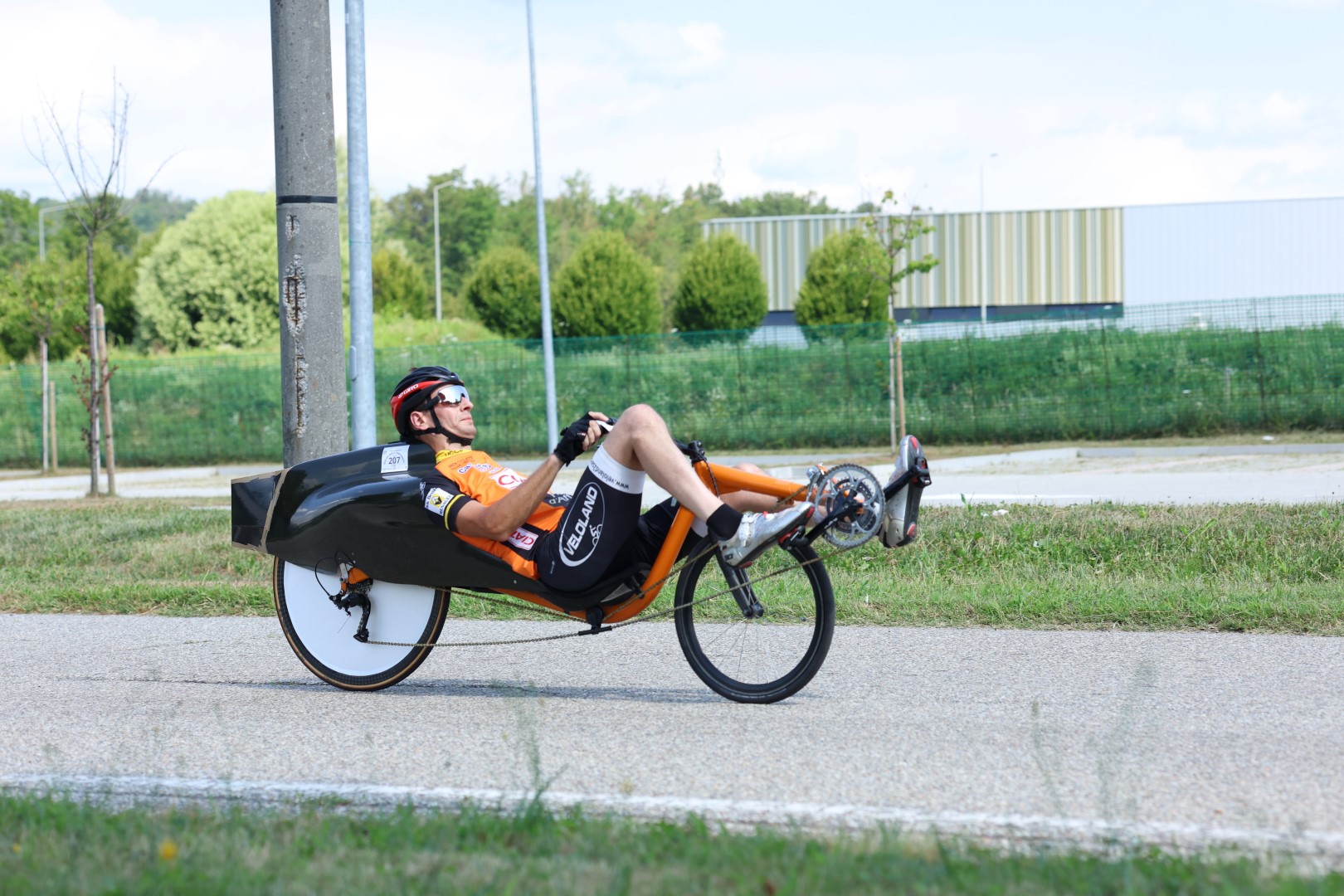
In July 2026 the Dutch and Belgian associations, NVHPV and HPV Belgium, shared the work at the Tom Dumoulin Bike Park in Sittard-Geleen. The opening fastest lap was followed by an hour trial, a climbing criterium and an endurance race shortened in the heat. NVHPV’s closing account counted 110 competitors and 45 volunteers. The organisers named nine class winners. They include Melchior Poppe and Bianca Behr in the unfaired divisions, Philippe Descubes and Judith Swallow in unfaired multitrack, and Kim Wall and Rindlisbacher in the fully faired divisions. Read the official list for the exact class names and the rest of the winners.
What would Kyle and Lambie recognise? The timing line, certainly, and the reflex to walk over to another machine and see how its builder solved a problem. They would find builders racing home projects alongside established designs, and volunteers working a long day so everyone else can do it. The difference is the size of the job the championship has grown into. It now takes several courses or several versions of one course, class and timing systems, marshals, local clubs and a weekend of decisions before the teams get their result.
Paul Cheneau / ASD Velocità a Pedali

Arnold Ligtvoet / WC26 · Organiser’s credit and reuse terms
Sources 2021 restart and programme Sloten and Spaarndam · race account Lustenau official points Betteshanger charts and results Lake Maggiore · official programme and timing NVHPV · 2026 closing report 2026 classes and champions
PROFILES AND WORKSHOPS
The people inside and outside the fairings
Start with a rider and follow the machine, or start with a builder and see what happened when someone else raced the design. The profiles below lead to results, projects and first-hand accounts. The organising names belong in the same history. Kyle and Lambie found a place to make the first experiment public. Bakker and Knoop kept a European championship alive. Bruckert and Future Bike CH put the machines before a wider audience in Interlaken. Each time the championships moved, a local group had to do the work all over again.
The first timing traps
Ron Skarin proved what Kyle’s fairing could do and won Irwindale’s first solo race. Allan Abbott combined a winning prone bicycle with the job of launching the association. Ralph Therrio made a hand-and-foot four-wheeler the fastest single-rider design in 1977. Gibby Hatton went from second in the 1975 solo race to the winning tandem crew in 1977.
Building for the straight
Jan Russell and Butch Stinton took White Lightning past the Abbott Prize threshold. Fred Markham connects the Gold Rush sprint to championship endurance racing. Georgi Georgiev built the Varna machines raced by Sam Whittingham and Barbara Buatois. Their results link European championship weekends to the separate record attempts in Nevada.
Ideas that travelled
Mike Burrows took ideas between recumbents, utility trikes and track cycling. Allert Jacobs and Ymte Sijbrandij brought everyday use into the Quest’s development. Daniel Fenn raced and developed velomobiles. Theo Schmidt opens a door into the Swiss network that worked on land, water and air.
Racing over a whole weekend
Ian Chattington and Rosmarie Bühler lead into the Brighton era. Jürg Birkenstock connects Swiss workshop design and racing. Nici Walde, Andrea Hämmerle, Judith Swallow and Christoph Rindlisbacher show the routes through endurance, vehicle class and overall results in recent editions.
Sources EHPVA legends The first generation of riders and builders All EHPVA rider and builder profiles
DESIGN AND RACING
Three races that show what changed
At Ontario in 1980, two riders took the Vector tandem above 100 km/h over 200 metres. The shape and the number of riders were part of the same design decision. At Ghent in 2000, the standing kilometre, four-hour criterium and open and unfaired divisions rewarded different things. The period’s lower recumbents and practical velomobiles could remain at the front without sharing either shape or weight.
Lustenau’s 2023 final results put an Alpha 7 first overall, three DF XLs immediately behind it and a DF at the head of the women’s results. Compare the Arona sprint and the climb from Meina in 2025 and even those examples need another qualification. A Milan led the flying sprint and a Birk Comet won the climb. This is how the evidence becomes useful. Start with the scoring and the course, then ask which vehicle was able to turn its advantages into a title.
Sources 1980 flying sprint register Ghent 2000 race sheets Lustenau official final rankings Lake Maggiore official timings Winning machines with their sources
WHAT SURVIVES
The figures we have and the gaps that remain
A championship can leave an entry list, a time sheet for one race, final points, a club magazine, an organiser’s estimate or a dozen photographs. Each tells us something different. A machine may have several people inside it, and a rider may appear on several sheets. The oldest documents even disagree within a single issue about one of the Vector’s speeds. The useful response is to leave enough of a trail for the next reader to see where a figure came from.
These checkpoints show how much of the story can already be compared if we keep the units visible. The count for Brantford comes from the numbered entries. The Leer count includes athletes from the land and water programme. The Betteshanger number is the event programme’s report. Lake Maggiore’s 94 are the riders in the final overall table. Sittard’s 110 are the organiser’s final competitors. None of those figures can stand for the number of vehicles that started every race.
| Edition | Published figure | What was counted |
|---|---|---|
| 1975 · Irwindale | 14 vehicles reported | Contemporary event narrative, with 15 rows in the printed results |
| 1976 · Irwindale | 26 vehicles | Reported vehicles, with 24 timed result rows |
| 1977 · Ontario | More than 50 entries | Entered vehicles, with 34 timed result rows |
| 1993 · Blaine | At least 58 vehicles | Land vehicles reported in the contemporary account |
| 1996 · Las Vegas | More than 100 expected | Advance estimate of entries by UNLV |
| 2002 · Brantford | 55 listed entries | Numbered entries on the published land entrants list |
| 2013 · Leer | 220 participants · 14 nations | Organiser’s report across disciplines |
| 2024 · Betteshanger | More than 125 riders | Figure in the organiser’s programme |
| 2025 · Lake Maggiore | 94 riders | Final overall classification |
| 2026 · Sittard-Geleen | 110 competitors · 45 volunteers | NVHPV’s report after the event |
The early championships still need reconciled lists of people and machines, with riders who entered, started and recorded a result identified separately. Where paper reports are all that survive, there is work to do on the full class standings, vehicle names and credits for the people behind the designs. More recent editions have gaps too. In Jersey, for example, photos and a contemporary rider’s diary document the races, but the full official classification is still sought. Photos of the first Irwindale meetings and original timing and entry sheets would add as much as another first-place name.
If you have a programme, result sheet, vehicle list, photograph or film, the date, place and names that go with it can be as useful as the image itself. The archive grows when those details can travel with the document. The next place to look is the edition that interests you most. Its race account leads back to the original sources and forward to the people and machines you can follow across the years.
Sources Human Power digital library Browse the championship editions Vehicle and class counts by edition Jersey entry in the archive Contact and contribution details in the archive
What it takes to put on a World Championship
At Irwindale a small organising group could put much of the question to a single speed trap. The club system developed around meetings that asked for more at every turn. A circuit needed people to check vehicles and space starts. A festival with racing on several surfaces needed people to move riders and spectators between venues. When the championships reached the Alps and the Dutch lowlands, national associations and local cycling clubs joined fire services, venue managers, municipalities and volunteers in changing combinations. The organisers’ register traces the credits back to programmes and reports.
Trust between clubs mattered when a meeting almost fell through. The Dutch recollection of the first European Worlds at Lelystad tells how Marielle Bakker and Sacha Knoop took the initiative. It also shows how quickly a championship could grow around a group of people who already knew who to call. In France, the trail goes from France-HPV at Allègre to AFV events at Saône, Nandax and Orgelet. Each reused skills learned through normal club racing and each had a different set of local roads and officials to work with.
In 2023, the organising committee had two countries to coordinate. The Swiss hill climb and the Austrian event base meant parallel permissions and separate local arrangements. More than 70 people volunteered for a meeting with 110 reported participants. In 2026 the Dutch and Belgian associations shared responsibility for the meeting at one main venue, and the Dutch report records 110 participants and 45 volunteers. That puts the work of a championship into perspective. A race sheet is a page with columns. Before any column can be filled, someone must close the road to traffic, test the timer, brief the riders and make sure a machine can pass inspection.

Herbert Heim / Wikimedia Commons · CC BY-SA 4.0

Saône 2014 · race footage
The surviving records are uneven. A printed programme might give the names of a race director and host club while the timing sheets give only the venue. Some early issues give enough to identify the people with the stopwatches and too little to confirm a formal local committee. Those gaps remain visible. Across the chapters, the event reports make it possible to read the championships on two scales, as tests for machines and as work carried from one group of volunteers to the next.
Sources · NVHPV club history and Lelystad · AFV’s championship archive · Austria–Switzerland organisers’ report · NVHPV’s Sittard report · Host countries and club profiles