10–12 July 2026 · Netherlands
Sittard-Geleen
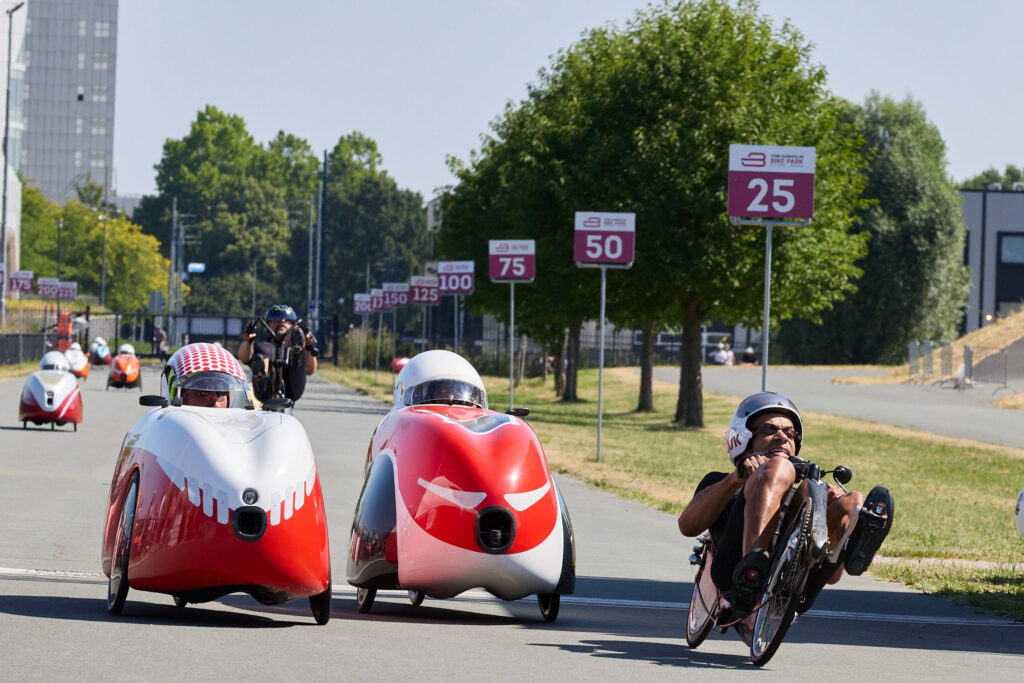
The Dutch and Belgian recumbent associations hosted the championship at the Tom Dumoulin Bike Park. The programme counted a fastest-lap race, a one-hour time trial, a climbing criterium and an endurance race. The three-hour endurance race was shortened to two hours. NVHPV’s post-race report counted 110 competitors.
NVHPV and HPV Belgium shared the organisation. The fastest-lap contest opened the racing on Friday. Saturday paired a sustained solo effort with the climbing criterium. The endurance race closed the championship on Sunday, with the published timing files recording the shortened two-hour event.
Championship report
Four races, three days in the heat
Sittard-Geleen opened with flying laps and ended with a shortened endurance race. The field brought machines built for outright speed, family projects brought back to life and a race weekend reshaped by the heat.
Friday 10 July
On the oval, one lap was all that counted
Riders and organisers opened the meeting with a parade. Later that evening the competitors set out on the first of the weekend’s four tests, a fastest lap on the Bike Park’s inner oval. It was a short way to start a championship that would soon ask riders to manage sustained pace, a steep ramp and a two-hour race.
The rules allowed riders up to ten laps including warm-up and cool-down. They could stop sooner once they had put in the lap they wanted. Riders went out individually in an order based on the hour-race speeds they had estimated when they entered. The timing archive kept separate sessions for the fully faired machines and the unfaired or partially faired classes.
For the rider who writes the Dutch-language Bicky blog, the race was a first outing in years for an M5 Low Racer that had seen barely any use. His son rode a Challenge Hurricane that they had repaired for the meeting after it had been discarded with damaged suspension. The father’s best lap averaged 44.5 km/h and the son’s 42 km/h, according to their account. Behind those figures was a family project that began well before Friday’s start.
Saturday 11 July
The hour in the morning, the steep ramp in the afternoon
The one-hour time trial began with riders going off at one-minute intervals on a circuit of roughly one kilometre. The faster riders were scheduled later. The classification was calculated from the distance covered in a full hour, with the fraction of the final lap estimated from the recorded timing. The Dutch timing team flagged missed transponder readings in its initial raw feed, so the final results are the better source for comparisons.
A rider writing for RC Musketier Wuppertal described averaging 42 km/h in the hour, interrupted by a technical stop. The club account also explains what the tighter turns meant to riders on three wheels. A velomobile stays upright through a turn, so the tyres must carry the lateral load. The rider tried a different outside-tyre and suspension setup during the weekend, a detailed example of how racers adapted their machines to the Bike Park.
In the afternoon the route changed. The climbing course was roughly 1.5 km and the short ramp reached 12.5 per cent. Every lap brought that ramp back into play. A rider who lost momentum near the base would pay for it on every ascent. The programme had announced 45 minutes plus a lap. The Wuppertal rider reported that the timed portion was cut to 35 minutes in the heat. The organiser’s photo log retains the originally advertised format, so the two sources record the plan and the participant’s experience respectively.
Programme and circuit rules · Timing notes · RC Musketier Wuppertal · rider report
Sunday 12 July
A two-hour finale and the rainbow jerseys
The organisers changed the endurance race after Saturday’s heat. It kept its morning start but finished one hour earlier than advertised. Riders still had to repeat a demanding lap for two hours. Vehicle setup, overtaking and pace through the corners became decisions that had to work again and again.
The Wuppertal rider reported 48 km/h in the shortened race. Bicky reported 37.6 km/h on his unfaired machine and 36.3 km/h for his son. These are individual recollections from two different classes and help show the range of machines on the circuit. The official standings below are the reference for the championship titles.
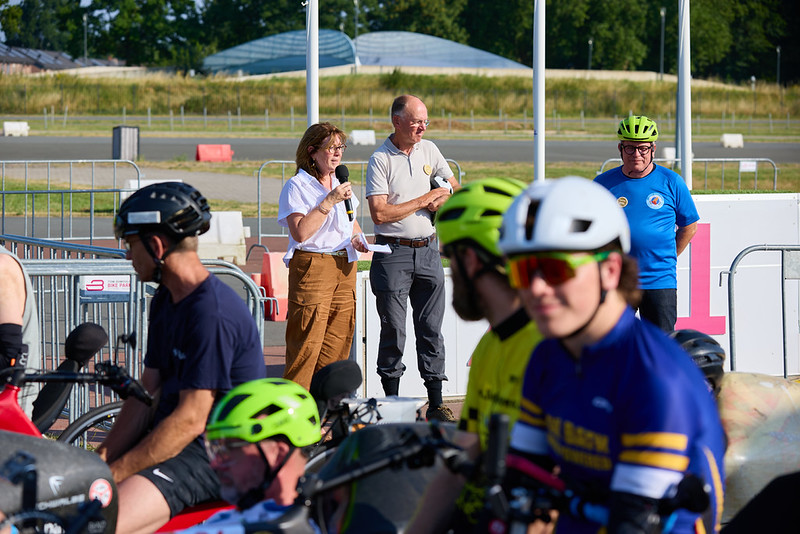
Peter Bouwels and the Bike Park helped make rainbow jerseys available for the winners. The organisers describe their presentation as a first for these championships. The titles were awarded by class, so the ceremony brought riders in streamliners, velomobiles, trikes and open recumbents to the podium.
Organiser’s race updates and retrospective · Official champions
Champions and contenders
Two- and three-wheel titles, and stories behind the start list
Christoph Rindlisbacher of Switzerland and Kim Wall of Britain won the men’s and women’s fully faired titles. Rindlisbacher had already won the men’s overall classifications in Lustenau in 2023 and at Lake Maggiore in 2025. Wall had placed second in the organisers’ women’s retrospective for Betteshanger 2024. Sittard’s class-based awards record where their titles fitted among nine winners.
In the unfaired classes, Switzerland’s Melchior Poppe and the Netherlands’ Bianca Behr took the titles. Fellow Swiss rider Michael Ammann won the men’s partially faired class. Ammann and Rindlisbacher both appear on the Swiss Future Bike team’s 2025 account, which puts them together near the head of the partially faired field at Lake Maggiore.
The fully faired multitrack winners were Germany’s Matthias König and Bianca Metz. The trike titles went to France’s Philippe Descubes and Britain’s Judith Swallow, who had finished second in the women’s overall ranking recorded for Lake Maggiore the previous year. These results show how much of the weekend’s story sits in the different classes. The two Swiss wins on either side of the fairing split are just as much a part of it as the trike and velomobile podiums.
Beyond the timing line
The cool clubhouse, a border ride and a Saturday raffle
The organisers’ closing account puts the turnout at 110 competitors from 13 countries, supported by 45 volunteers. The early publicity gave a larger entry count. The two figures describe different stages of the event. The final turnout better reflects who actually arrived in Sittard.
Riders could recover in the clubhouse, where Andrew Sidwell singled out the air conditioning and the café in his note to the organisers. Overnight camping was unavailable inside the park, so the event arranged accommodation at Watersley hostel and nearby campsites. The volunteers welcomed riders with Limburg pie and served food throughout the weekend.
Outside the adult races, a small group took the three-country ride organised by De Grensrijder, while children raced on the central course and were cooled with water spray in the heat. Rudi Cools of HPV Belgium organised a Saturday evening prize draw, and the fair gave cycle builders and visitors a place to look over the machines up close. The NVHPV also published a special, mainly English-language issue of Ligfiets&. Arnold Ligtvoet’s photographs capture many of these moments away from the finish line.
The people behind the racing
NVHPV’s post-race report counted 110 competitors and 45 volunteers. Jorie and Jeroen Peeters supported the volunteer team, while Peter Bouwels and the Bike Park staff helped put on the event and arrange rainbow jerseys for the champions. Between races, visitors could try machines and talk to makers at the fair. ICE brought trikes from the UK, while Dutch and Belgian suppliers exhibited alongside them.
NVHPV · closing report and photo credits · Organisers’ photo and film archive

Arnold Ligtvoet · Sittard-Geleen, July 2026

Arnold Ligtvoet · Sittard-Geleen, July 2026
Arnold Ligtvoet · Sittard-Geleen, July 2026

Arnold Ligtvoet · Sittard-Geleen, July 2026
Championship photo gallery


Race results and classifications
| Category | Riders |
|---|---|
| Fully faired | Christoph Rindlisbacher (men), Kim Wall (women) |
| Unfaired | Melchior Poppe (men), Bianca Behr (women) |
| Fully faired multitrack | Matthias König (men), Bianca Metz (women) |
| Trikes / multitrack | Philippe Descubes (men), Judith Swallow (women) |
| Partially faired men | Michael Amman |
Raw timing from the official provider
Race programme and reports
- Friday · Fastest lap
- A single best lap set the opening result.
- Saturday · One-hour time trial
- Solo distance and timing over an hour.
- Saturday · Climbing criterium
- The climbing circuit gave the weekend a separate hill test.
- Sunday · Endurance
- The scheduled three-hour race ran for two hours.
Photographs and films


Photo collections
Video and race footage
Official championship highlights
The fleet at Sittard-Geleen
The published competitor list contains 117 names under five headings, including 48 fully faired multitrack and four fully faired single-track. Those counts follow the entry list’s headings. The race-by-race timing and category podiums are available in the separate results.
Original reports, results and media
- Organisers · published competitor list
- Organisers · four-race programme
- NVHPV · finals and race timing
- Organisers · champions by class
- Organisers · photographs, interviews and race films
Champions and class titles · Vehicle statistics · HPV Legends
Riders and machines
- Christoph Rindlisbacher
Men’s fully faired winner - Matthias König
Men’s fully faired multitrack winner - Michael Ammann
Men’s partially faired winner - Melchior Poppe
Men’s unfaired winner - Philippe Descubes
Men’s unfaired multitrack winner - Judith Swallow
Women’s unfaired multitrack winner - Kim Wall
Women’s fully faired champion. - Bianca Metz
Women’s fully faired multitrack champion. - Bianca Behr
Women’s unfaired champion.