HPV people · inventor, racer and organiser · 1943–2022
From the Windcheetah to Olympic gold
Mike Burrows helped found the British recumbent racing scene and took his ideas into Olympic cycling, road racing and everyday transport. His most famous bicycles show four different answers to one question: what does this rider actually need the machine to do?
Brighton 1980 and the Windcheetah
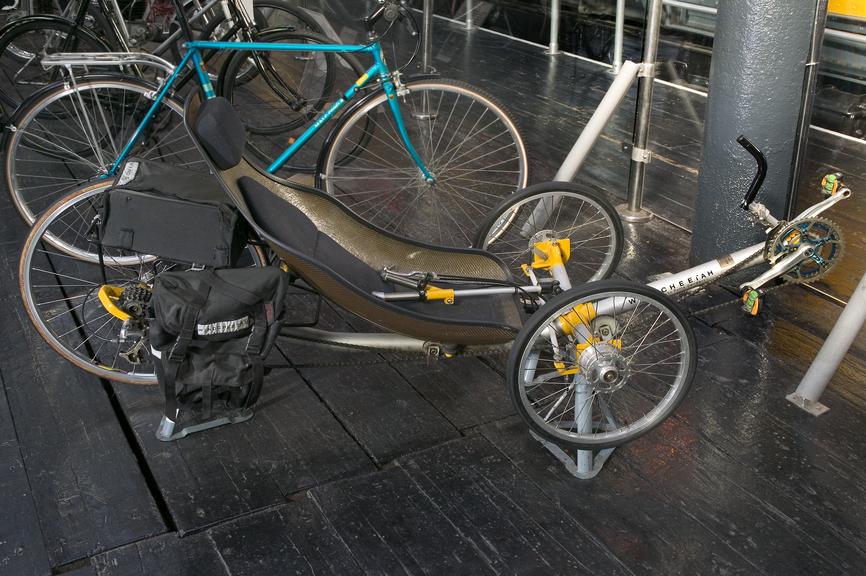
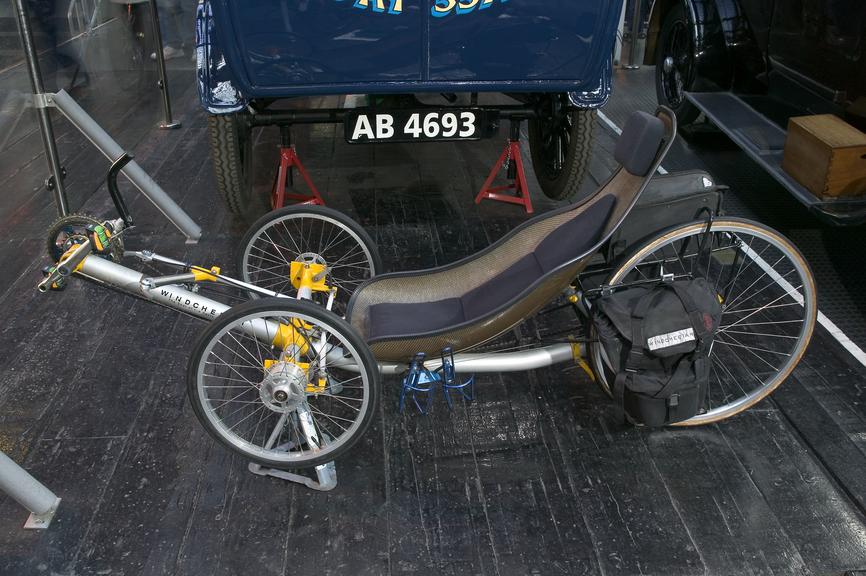
At the Aspro Clear Speed Trials in Brighton in 1980, Mike Burrows saw cyclists chasing speed on machines that did not need to resemble a conventional racing bicycle. He went home and built a recumbent tricycle. Originally called the Speed Machine, it became the Windcheetah, also known as the Speedy. A pair of front wheels supported a low seat, with the pedals out in front and a single driven wheel behind. It was a machine he could keep developing and ride himself.
When the British Human Power Club was formed in 1983, Burrows became its first chair. The significance of the club was practical. Builders and riders could share a circuit, compare ideas and see whether those ideas survived a race. A later Windcheetah T.I. appeared in the Museum of Modern Art’s 1995 exhibition on materials and design. What had started as a response to a speed trial had also become an exhibit about how things are made.
From the Norwich workshop to Barcelona
As a teenager Burrows had designed and built model aircraft. The work gave him a hands-on way of thinking about drag, structure and surfaces. He brought that knowledge to cycling alongside his work making packaging machinery. By the 1980s he was experimenting with aerodynamic monocoques, where the shell does the structural work that separate tubes normally carry.
Cycling UK records an early aerodynamic monocoque in 1984. The later Burrows Mk2 already had the single-blade fork that would make the Lotus machine easy to recognise from the side. The Mk2 also had a personal touch that never made it onto the Olympic bike: birds painted over water, reflecting Burrows’s interest in birdwatching.
Lotus Engineering developed the design with Burrows. Chris Boardman rode the Lotus 108 to the 4,000 m individual pursuit gold at the 1992 Barcelona Olympics. The stage belonged to Boardman, while the machine showed how ideas pursued in a small workshop could reach the track through collaboration with an engineering team.


A road bike that changed the shape of the peloton
Burrows worked with Giant’s research and development team on the MCR monocoque and on a different project with a much wider audience. The TCR, or Total Compact Road, brought compact geometry to the racing road bike. Its sloping top tube allowed the visible triangle of the frame to shrink. Fit could be adjusted with the seatpost and cockpit across a smaller range of frame sizes.
Spanish team ONCE raced the TCR, putting the idea in front of the professional peloton. Other manufacturers adopted the sloping top tube on their own designs. Burrows was also involved in Giant’s Halfway folding bike. The workshop habit remained the same across both machines: identify what the rider needs, then reconsider which parts of the conventional bicycle are actually necessary.
The bike for a working day
With the 8Freight, Burrows addressed the everyday problem of carrying things. An extended chassis gave the bike a large, low load platform behind the rider. Its design makes the purpose visible from the first glance, just as the Lotus makes its purpose visible through the shape of its frame.
Burrows also kept riding and racing recumbents. Cycling UK recalls him finding more speed from the machines as he grew older, keeping his performance up through engineering. For his sixtieth birthday he rode about 170 miles on a Ratcatcher recumbent. The episode gives a sense of the distance between an invention on a drawing board and a bicycle its inventor wants to spend a whole day riding.


Mike Burrows in his own words


Sources and further reading
- Cycling UK · Mike Burrows, 1943–2022
- MoMA · Windcheetah T.I. exhibition checklist
- Science Museum Group · LotusSport bicycle
- Giant Group · Burrows and the TCR