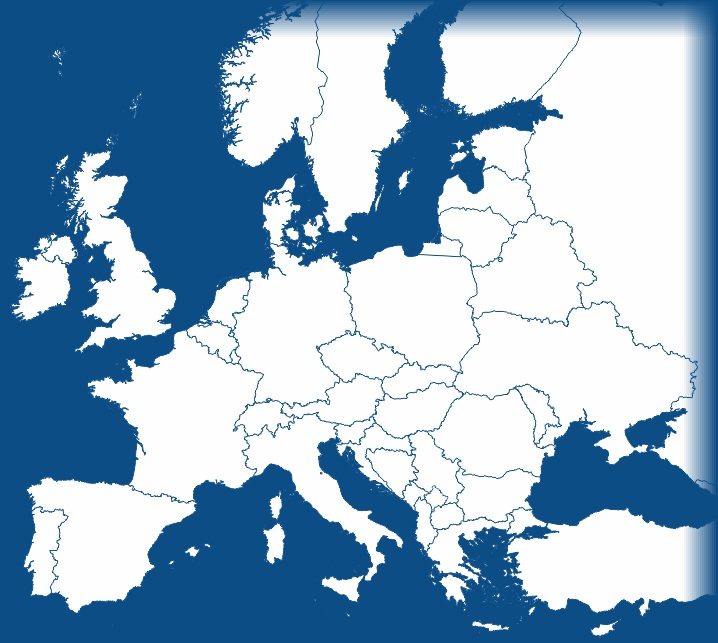
Modern championships · 2010–2026
The modern Worlds bring unfaired bikes, trikes, velomobiles and streamliners to the same festival. The original lap sheets let us compare what riders brought and why a machine could lead on one course and lose its advantage on the next.
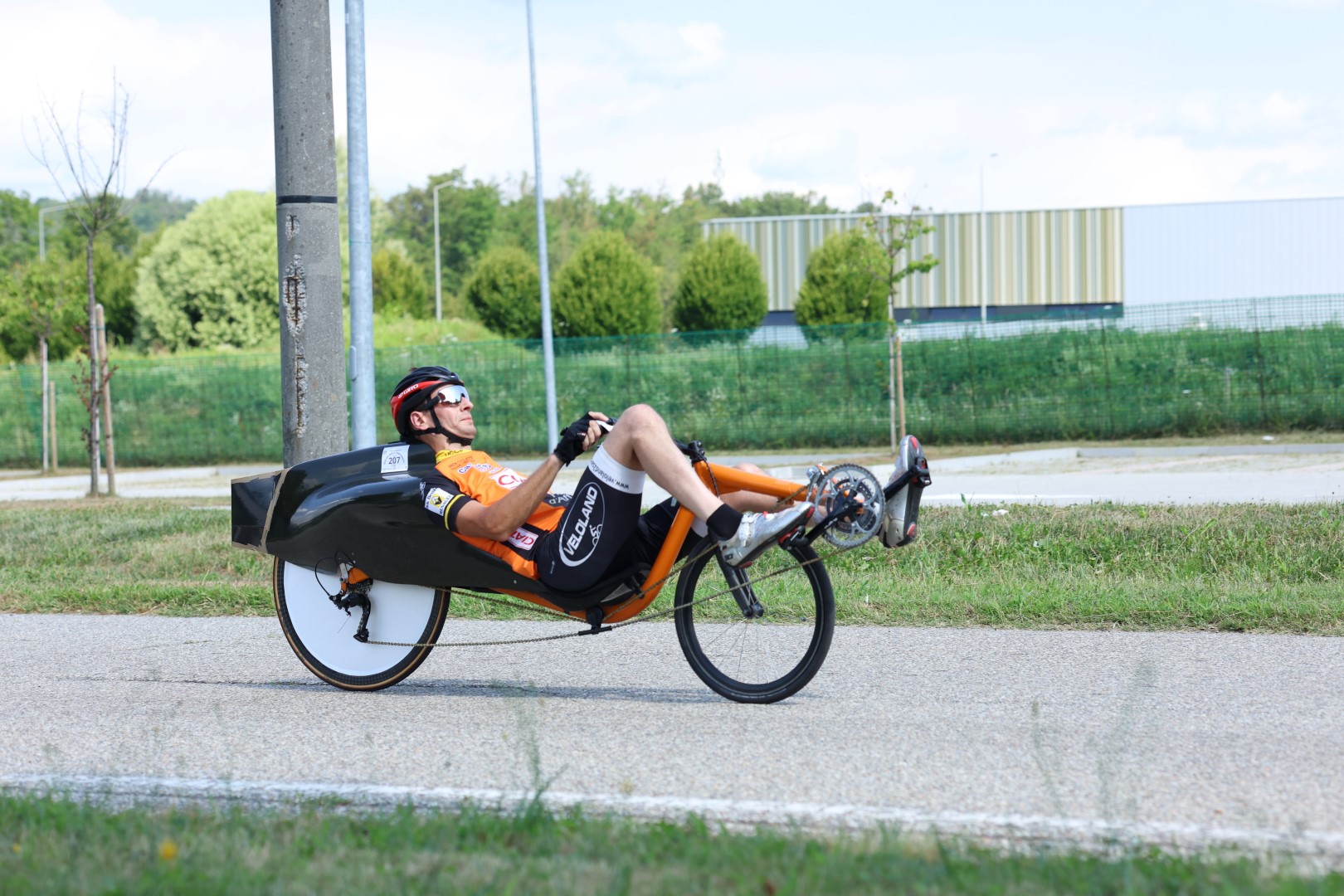
Paul Cheneau / ASD Velocità a Pedali
The course makes the championship
In Saint Helier in 2010, riders turned through streets laid out for a town. At Monza the following year, the motor circuit provided an altogether different venue. Leer in 2013 added land and water disciplines and reported 220 participants across its programme. Daniel Fenn’s onboard film makes one difference between those settings obvious. A road racer has to leave space to pass, read the rider in front and keep a pace that works for a whole circuit. A sprint’s final speed gives none of that away.
The 2017 hour-race worksheet for Mannheim prints 36 velomobile-coded rows out of 114 ranked in that discipline. At Nandax in 2019, the programme combined a climb, speed tests and a rolling 100 km circuit. In the published combined ranking the fields include 29 fully faired, 12 partially faired, 47 unfaired and 26 trike or trike-tandem entries. These codes describe the class structure an organiser used. The same machine can appear under a different class label in another year.
The race formats continued to change after the 2020 cancellation. In 2021, the Dutch organisers split the meeting between Sloten and WheelerPlanet near Spaarndam. The race programme moved from an elimination race to a one-hour trial and criterium, then to three- and six-hour races. A design that shed heat and let a rider stay comfortable for hours had something to offer alongside its outright speed. That range of tasks is part of what makes modern overall points worth reading round by round.

Man vyi / Wikimedia Commons · Public domain

Daniel Fenn’s onboard race footage, 2013.
Sources Jersey Monza Leer Mannheim and Nandax source notes Amsterdam and Spaarndam results
Counting the machines that turn up
The DF and DF XL provide the clearest example of a family appearing repeatedly in the surviving model lists. Count both variants together and there are 12 entries in Amsterdam’s 2021 final scores and 17 in Lustenau’s 2023 final classification. At Lake Maggiore in 2025 there are six in the registration data. At Nandax in 2019 the final table includes twelve entries named DF and ten named ICE VTX. That last number is about participation in the classifications, regardless of who won.
Family names help with reading several registers together, but they hide differences between models and generations. A DF XL has its own row in an exact-model count, just as a Birk Comet RT has its own row. A registration sheet may list riders who never start. A final sheet can exclude someone who had a mechanical problem or only rode one round. The archive therefore keeps the kind of document with each number.
| Models or family | Amsterdam 2021 | Lustenau 2023 | Lake Maggiore 2025 |
|---|---|---|---|
| DF family | 12 | 17 | 6 |
| Birk Comet family | — | 5 | 4 |
| Milan family | 3 Milan SL | 1 Milan | 4 |
| Snoek | 3 | 3 | — |
| Alpha 7 | — | 6 | — |
| Quest family | 4 | 2 | — |
| WAW | — | 3 | — |
| ICE VTX | — | 3 | — |
Lustenau’s overall sheet contains 107 ranked entries and three tandem rows. Its fully faired codes cover more than one wheel layout. Lake Maggiore lists streamliners apart from velomobiles. Sittard’s 2026 roster labels four as fully faired single-track and 48 as fully faired multitrack. The difference helps readers find the machines they mean when they say “streamliner”; the word can otherwise be used for almost any enclosed racing vehicle.
Sources Full model comparison with source notes Separate streamliner counts Lustenau official ranking Sittard competitor list
How the innovation shows up in race results
In Lustenau the organisers gave the hill climb and 100 km race more combined weight than the three sprints. Christoph Rindlisbacher took the men’s overall in an Alpha 7, with DF XLs in the next three places. A year later at Betteshanger, the formula awarded 2,000 points to the winner and 95 percent of the previous place’s points to each lower finisher. The same idea of an overall title therefore rewarded different performances. A reader can get much closer to what happened by putting the rules next to the podium.
Lake Maggiore is a useful comparison because the courses ask such different questions. In the flying 100 m, Jonathan Schmidt recorded 4.894 seconds on a Milan SL Mk4. In the standing 400 m, accelerations and available grip mattered from the first pedal stroke. Julien Francallet recorded the quickest 400 m on a partially faired recumbent. Rindlisbacher led both the long race and the final climb on a Birk Comet. Four rounds were enough to show three different ways of being quick.
A low frontal area and a smooth shell make sense when a rider is holding high speed. A climb makes total mass more noticeable. Tight corners change the value of braking, sight lines and how easily a rider can regain speed. Carbon composites expanded what builders could mould into a shape. They did not remove those choices. The strongest evidence for an innovation often comes when a machine succeeds in a different event from the one it was expected to win.
At Sittard-Geleen in 2026, heat made the organisers shorten the endurance finale. The championships published separate winners for the unfaired, trike, partially faired, fully faired and fully faired multitrack divisions. Their final report counted 110 competitors and 45 volunteers. The start sheets and individual timings make it easier to reconstruct the racing than in the first decades. The names of every machine and every rider substitution still need care.

Arnold Ligtvoet / WC26 · Credit and reuse terms
Sources Lustenau programme and scoring Betteshanger programme and scoring Official Lake Maggiore results Sittard champions Sittard final report
Three French championships and three ways to use a landscape
At Saône in 2014, the AFV programme scattered the racing around the Besançon area. The climb to Montfaucon set a different problem from the sprints at La Vèze. A long climb keeps a rider working at relatively low airspeed, where the machine’s mass matters on every metre gained. On a paved sprint strip, once the machine is moving quickly, reducing drag buys more speed for the same effort. Put both events on the schedule and a designer has to decide where to spend weight, where to leave space inside the shell and how to gear the bike for both ends of the weekend.
Five years later, the Loire made those trade-offs unusually easy to see. At Nandax 2019, the hill climb at Jarnosse was about five kilometres. Vougy supplied the surface for the flying 200 metres and the kilometre from a standing start. The 100 km road race at Nandax then took the same championship back to public roads. A rider in the flying sprint could build speed ahead of the measuring line. In the standing kilometre, the result included the work of getting the vehicle up to speed. In an endurance race, braking, corner exits and the ability to sustain effort all re-entered the calculation. These were three different reasons for the same vehicle to be fast.
The Jura Worlds of 2022 put a climb at Bellecin, timed sprints at La Tour-du-Meix in the Moutonne area, and the closing road race around Rothonay on the same weekend. The courses depended on several communities. The race films also show what a result sheet leaves out, including how close riders run to the edge of a narrow road and how much line choice changes at speed. Local road layouts can shape the competition as much as the category definitions do.

Saône 2014 · race footage
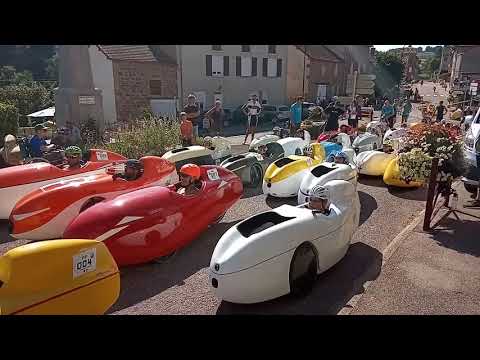
Nandax 2019 · opening day footage

Recumbent.news
Sources · AFV 2014 programme · AFV reports and courses · French organisers and editions
A border crossing and a park shared by two clubs
The 2023 Worlds came together when another French edition looked unlikely. At Orgelet, Werner Klomp offered to find out whether Vorarlberg could host it. The first organising meeting took place at Rapperswil. The eventual plan joined Liegeradclub Vorarlberg and Future Bike Switzerland, with the event base at Lustenau in Austria and the hill climb starting in St Margrethen in Switzerland. It meant road permits on two sides of the border, plus arrangements for timing, accommodation information, catering and insurance. A week before the races the organisers were still waiting for resurfacing on part of the 100 km course. Lustenau had the surface ready in time.
The published programme gave the climb a quarter of the overall score, the three sprints an eighth each and the 100 km race three eighths. The weights show how much a fresh rider could gain on Friday’s hill and how much the final road race could still move the standings. The organisers’ retrospective reports 110 participants and more than 70 volunteers. Those numbers include two kinds of effort that rarely turn up together in the results. The class PDFs are the place to look for who was classified.
Three years later, the Netherlands and Belgium also worked together, with the racing concentrated at the Tom Dumoulin Bike Park in Sittard. The Dutch club’s appeal describes the work of checking bikes, registering arrivals, recording results, marshalling and keeping spectators informed. The final club report counts 110 participants and 45 volunteers. It also records the change from a three-hour race to two hours on a hot weekend. Results and race reports each preserve something different about how the event actually ran.

Herbert Heim / Wikimedia Commons · CC BY-SA 4.0

Watch the film
Sources · Organisers’ 2023 retrospective · 2023 programme and points weights · 2026 volunteer briefing · 2026 post-race report
From a former colliery to the roads above Lake Maggiore
At Betteshanger in 2024, a country park on a former colliery site could accommodate repeated laps. A rider’s position on a lap chart could be compared with their fastest lap, and both could be compared with where they finished. A short fast lap rewards a different effort from a long race, in which finding a pace and making clean passes over and over can be decisive. The British Human Power Club programme, the published results and Russell Bridge’s onboard film make it possible to follow all three views of the same course. In the film the gaps between groups, sight lines and passing opportunities are visible.
The 2025 programme above Lake Maggiore brought several different tasks together again with a flying 100 metres, a 400-metre standing start, a climb and long road racing. The Italian event site preserves the course descriptions alongside the results and galleries. Braking going into a bend and accelerating again after it can decide how much of a machine’s straight-line advantage survives on a road loop. A comparison between the short sprint and a road result becomes much more informative once each course is visible.
This is why each edition in the archive accompanies the placing with the race format wherever the source supplies it. The name of a machine and a single maximum or average speed can tell only part of the story. With the distance, starting method, class, surface and standings in view, the same figures also tell us which compromises worked on that weekend.

Nick Smith / Geograph · CC BY-SA 2.0

Betteshanger 2024 · Russell Bridge
Sources · British Human Power Club 2024 programme · 2025 programme, routes and results · Betteshanger results and media · Lake Maggiore results and media